A Strategic Engineering & Cost Analysis for Pharmaceutical Capital Investments
For pharmaceutical manufacturers, contract development and manufacturing organizations (CDMOs), and compounding pharmacies, selecting a primary packaging line is a high-stakes decision. In the sterile processing of injectables, your liquid filling equipment directly influences your operational costs, batch validation success, compliance risk, and speed-to-market.
When scaling up production or establishing a new parenteral line, the most fundamental fork in the road is deciding between Automatic and Semi-Automatic ampoule filling and sealing machinery.
Choosing incorrectly carries severe consequences. Under-investing in automation can lead to chronic bottlenecks, high human contamination risks, and failed regulatory audits. Conversely, over-investing in a fully automated line too early can lock up critical capital, reduce operational flexibility for low-volume batches, and yield a poor return on investment (ROI).
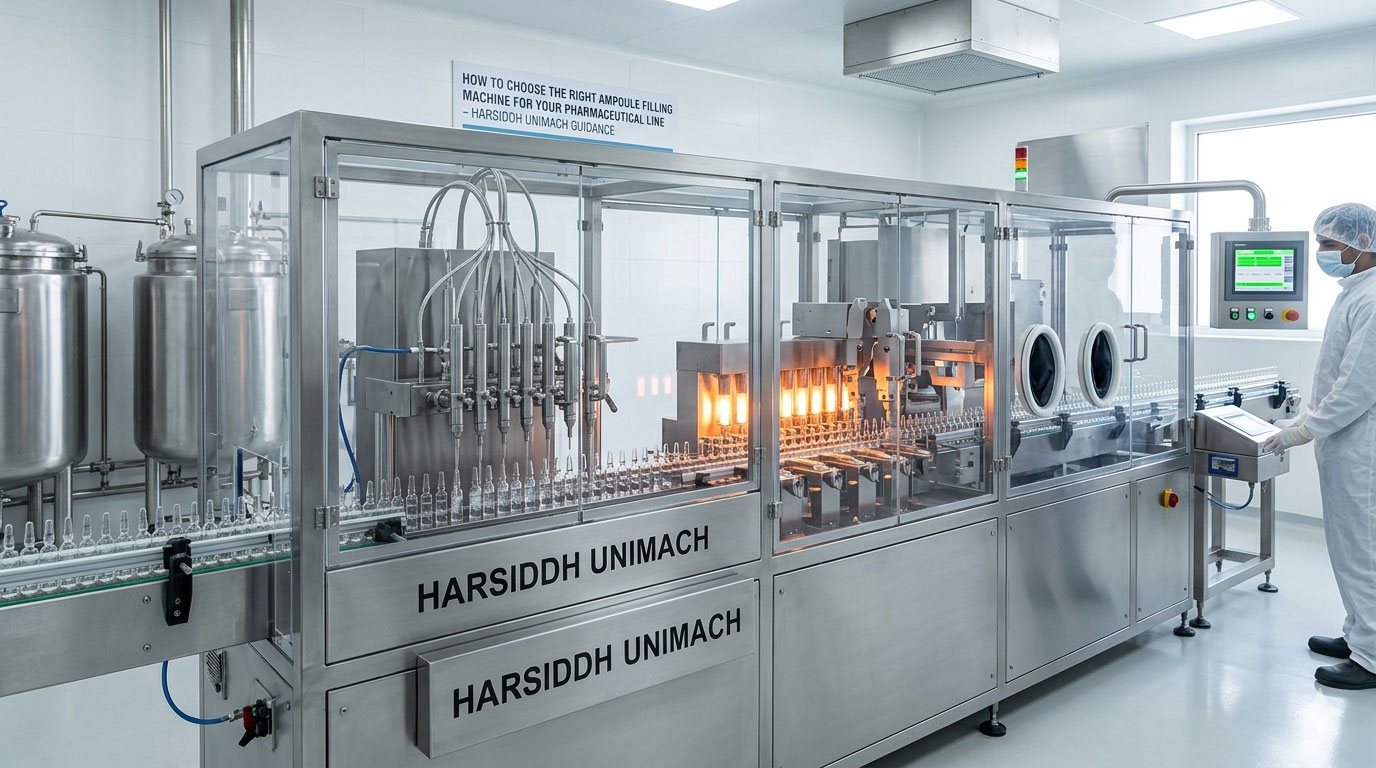
As a trusted global leader in high-performance pharmaceutical machinery, Harsiddh Unimach designs, engineers, and deploys both advanced automatic processing lines and highly precise compact semi-automatic systems.
This comprehensive guide delivers an objective, engineering-focused comparison to help your procurement and production teams select the optimal technology framework for your facility.
1. Operational Overview: Mechanical Frameworks & Workflow Dynamics
To evaluate which system fits your operational reality, we must first look past the marketing terminology and analyze the mechanical workflows, human touchpoints, and processing physics of both configurations.
SEMI-AUTOMATIC WORKFLOW:
[Manual Feed] ──► [Auto Flush & Dose] ──► [Manual Transfer] ──► [Auto Sealing Burners]
                                                                        ▲
                                                                  (Human Risk)

AUTOMATIC WORKFLOW (Monoblock/Inline):
[Infeed In-line] ──► [Auto Nitrogen Purge] ──► [Auto Servo Dosing] ──► [Auto Draw-off Sealing]
The Semi-Automatic Workflow Architecture
In a semi-automatic configuration, the machine automates the highly precise core functions—such as liquid volume delivery via volumetric pumps and neck fusion via gas-oxygen burners—but relies on human operators for material handling and transport.
- Infeed & Loading: An operator manually loads empty, sterilized glass ampoules onto an indexing tray or feed comb.
- Dosing & Flushing: The machine automatically indexes the ampoules under the filling needles. It performs pre-nitrogen flushing, delivers the exact fluid dose, and completes post-filling gas flushing.
- Transfer to Sealing: The operator manually transfers the filled, open ampoules from the filling rack to the sealing station.
- Sealing Execution: The sealing station rotates the ampoule automatically inside a gas-oxygen flame array. Depending on the machine model, the operator or a basic mechanical assist pulls the heated glass tip to achieve the hermetic closure.
The Automatic Workflow Architecture
Fully automatic ampoule lines operate as a continuous, untouched stream. They are engineered to eliminate human physical contact entirely from the moment the glass enters the cleanroom enclosure until the sealed ampoule discharges to the inspection line.
- Infeed Synchronization: Empty ampoules feed automatically via a stainless steel conveyor belt or an integrated depyrogenation tunnel outfeed. A progressive, variable-pitch rotary scroll gently separates and organizes the glass containers into the processing line.
- Continuous Transport: Walking combs capture each ampoule, moving them smoothly through successive, automated stations: pre-gas purging, liquid dosing via advanced rotary piston or peristaltic pumps, post-gas purging, pre-heating, and final draw-off sealing.
- Automated Tip Discharge: Motorized mechanical tongs pull the glowing glass waste away cleanly, discarding it down a dedicated chute. The sealed ampoules are then automatically transferred to the exit conveyor for visual or leak-detection testing.
2. Production Throughput, OEE, and Scalability
The most immediate differentiator between automatic and semi-automatic systems is production throughput. However, engineers must look closely at Overall Equipment Effectiveness (OEE) rather than just maximum nominal speeds.
+------------------------------------+------------------------------------+
| Semi-Automatic Systems             | Fully Automatic Machinery          |
+------------------------------------+------------------------------------+
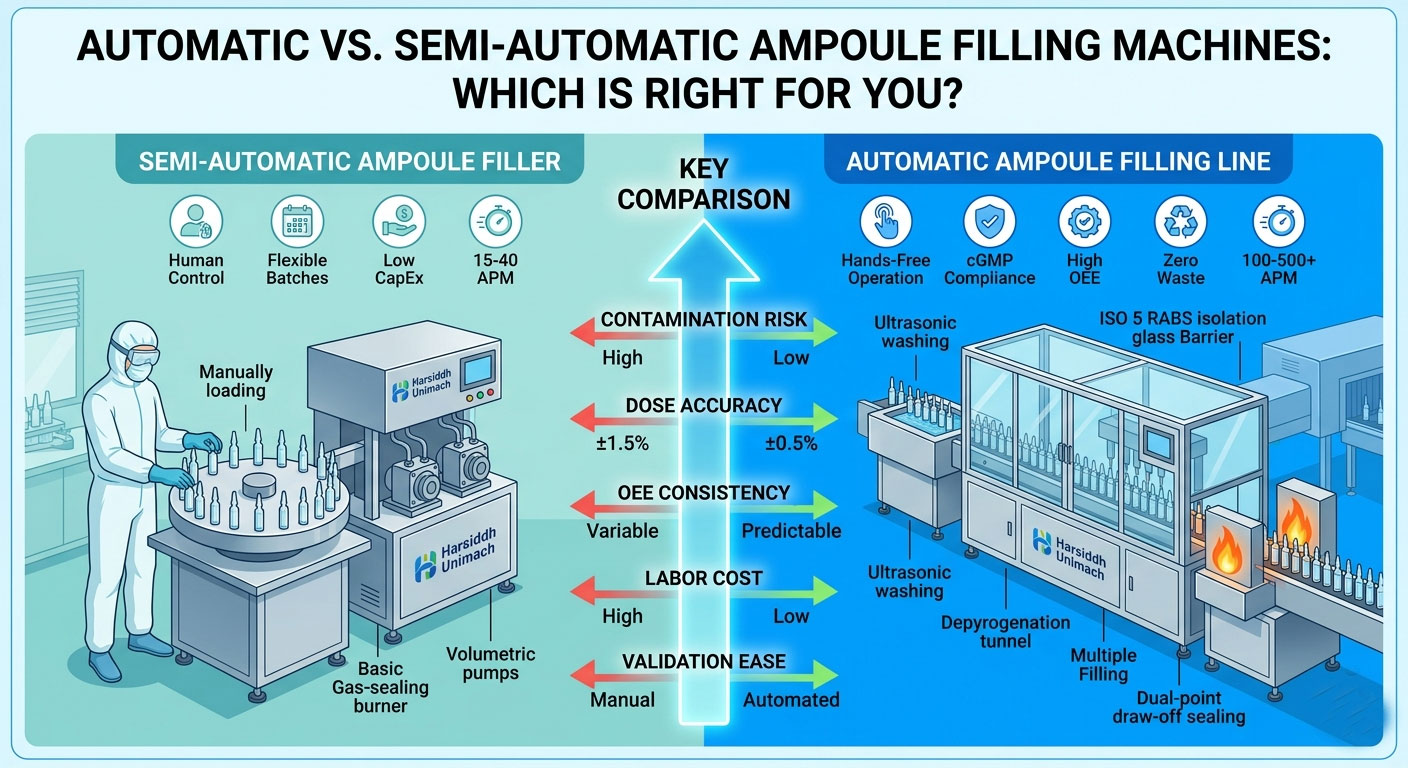
| • Throughput: 15 to 40 APM         | • Throughput: 100 to 500+ APM      |
| • Heavily limited by human fatigue | • Limited only by mechanics & fluid|
| • OEE varies based on operator     | • Predictable, consistent OEE      |
| • Best for small-batch diversity   | • Best for high-volume campaigns   |
+------------------------------------+------------------------------------+
Volume Capabilities: Ampoules Per Minute (APM)
- Semi-Automatic Output: Typically yields between 15 and 40 APM (approximately 900 to 2,400 units per hour). This throughput is variable and directly dependent on the speed, skill, and stamina of the human operator.
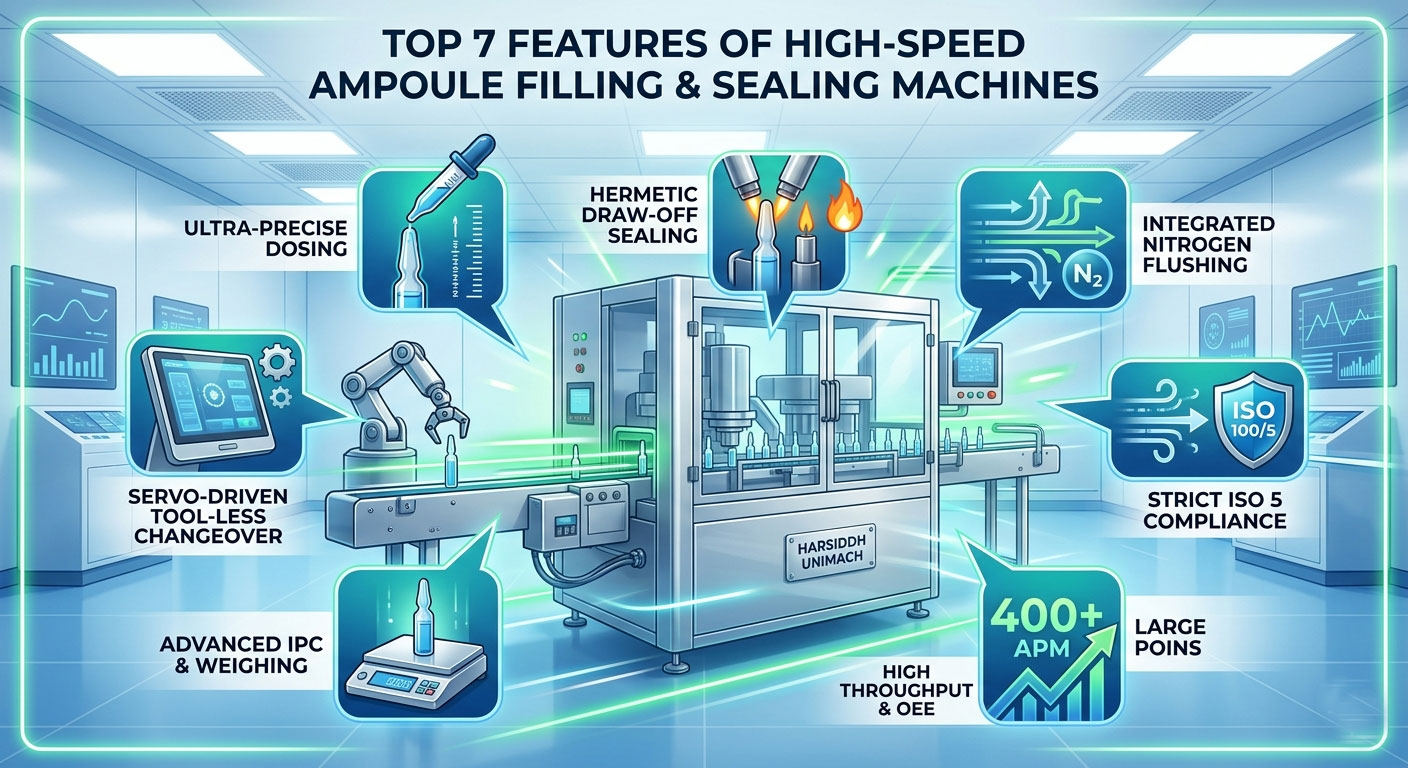
- Automatic Output: High-speed automatic lines effortlessly maintain speeds ranging from 100 to over 500 APM (6,000 to 30,000+ units per hour). The pace is governed entirely by electronic servo-drives and fluid dynamics, ensuring constant, uninterrupted output.
Factor In Fatigue and OEE
In semi-automatic setups, OEE inherently degrades over a standard 8-hour shift. As human operators fatigue, loading times slow down, the physical transit time between stations increases, and the risk of accidental glass breakage rises.
An automatic system from Harsiddh Unimach operates with highly predictable efficiency metrics. It maintains identical cycle times hour after hour, enabling your plant managers to forecast batch completion times down to the exact minute.
3. Human Contamination Risk and Regulatory Compliance (cGMP & Annex 1)
In sterile parenteral manufacturing, humans are the largest source of particulate and microbial contamination. International regulatory standards, including the US FDA’s current Good Manufacturing Practices (cGMP) and Europe’s stringent EU GMP Annex 1 revisions, place immense emphasis on reducing human intervention within critical Class A / ISO 5 cleanroom zones.
The Compliance Challenge of Semi-Automatic Lines
Because semi-automatic machines require operators to handle open, sterile ampoules between the filling and sealing steps, they are highly restricted under modern regulatory frameworks.
- Application Scope: These systems are typically limited to small-scale clinical trial batches, university research, localized compounding pharmacies, or non-sterile veterinary and cosmetic manufacturing.
- Validation Overhead: Securing sterile validation from the FDA or EMA for a human-dependent semi-automatic line running injectables requires rigorous environmental monitoring, frequent media fills, and intense justification protocols.
The Compliance Superiority of Automatic Lines
Automatic systems are built to isolate the product completely from the cleanroom workforce.
- Barrier Isolation: The streamlined, linear design of modern automatic lines allows them to fit perfectly underneath Restricted Access Barrier Systems (RABS) or within hermetically sealed Aseptic Isolators.
- Hands-Off Processing: From loading to sealing, the product remains untouched. This dramatically reduces bioburden and particulate risks, smoothing your path to successful regulatory validation.
4. Dosing Accuracy, Seal Quality, and Product Waste
When manufacturing expensive APIs, biologics, or cytostatic therapies, even a fraction of a percent of product waste can add up to significant financial losses over a production year.
  [ SEMI-AUTOMATIC RISK ]                      [ AUTOMATIC STABILITY ]
  - Manual transport jitter                    + Smooth, vibration-free tracks
  - Liquid splashing in neck                   + Precise servo needle entry
  - Flame alignment drift                      + Digital mass flow regulators
            │                                             │
            ▼                                             ▼
  [ Higher Product Waste ]                     [ Minimal Rejection Rates ]
Precision Dosing Engineering
- Semi-Automatic Mechanics: While the pumps on a semi-automatic machine are accurate, the manual movement of the containers can introduce liquid splashing up into the ampoule neck. If product residue clings to the neck during sealing, it burns, creating black carbon deposits that ruin the batch’s cosmetic and chemical purity.
- Automatic Mechanics: Automatic fillers utilize sophisticated servo-driven diving nozzles. The needles descend deeply into the ampoule body, execute a controlled bottom-up fill, and withdraw with precise acceleration profiles to ensure no trailing drops stick to the sealing zone.
Sealing Consistency and Container Closure Integrity (CCI)
Achieving a flawless, leak-proof tip or draw-off seal requires uniform thermal exposure. In semi-automatic configurations, slight variations in how long an ampoule dwells in the burner flames can result in asymmetrical seals, thin glass walls, or tiny micro-holes (capillaries).
Fully automatic lines rotate each ampoule at an exact, digitally synchronized speed inside stabilized flame paths fueled by electronic gas mixers, delivering consistent Container Closure Integrity across millions of units.
5. Capital Investment, Operational Cost, and ROI Analysis
Choosing between these two technologies requires balancing up-front Capital Expenditure (CapEx) against long-term Operational Expenditure (OpEx).
+--------------------------+----------------------------+----------------------------+
| Financial Parameter      | Semi-Automatic Machine     | Fully Automatic Line       |
+--------------------------+----------------------------+----------------------------+
| Initial CapEx            | Very Low                   | High to Very High          |
| Cleanroom Floor Space    | Minimal                    | Substantial                |
| Labor Overhead (per unit)| High                       | Extremely Low              |
| Maintenance & Changeover | Low / Basic Mechanics      | Requires Technical Skill   |
+--------------------------+----------------------------+----------------------------+
The Semi-Automatic Financial Profile
- Advantages: Exceptionally low initial purchase price, minimal installation costs, and a compact footprint that saves expensive cleanroom floor space. It requires basic maintenance and minimal utility hookups.
- Disadvantages: High labor costs. To scale production, you must hire more operators, multiplying your ongoing labor expenses and training overhead.
The Automatic Financial Profile
- Advantages: Minimal labor overhead per batch. A single operator can monitor a high-speed automatic line that does the work of 10 to 15 semi-automatic units. Product waste is nearly eliminated, and the risk of costly batch rejections is minimized.
- Disadvantages: Substantial initial capital investment. It requires specialized engineering setup, complex validation documentation, and highly skilled technicians to manage cleanroom automated systems.
6. How Harsiddh Unimach Helps You Choose and Succeed
At Harsiddh Unimach, we don’t believe in a one-size-fits-all approach. We understand that your choice depends entirely on your specific market positioning, budget constraints, regulatory environment, and production targets.
Here is how Harsiddh Unimach evaluates your needs and partners with your organization to deliver the perfect primary packaging solution.
When We Recommend Harsiddh Unimach Semi-Automatic Solutions
If you are an R&D laboratory, a clinical trial manufacturer, a pilot plant, or a specialized cosmetic producer dealing with small, diverse batches (e.g., 500 to 5,000 units per batch) of non-oxidizing liquids, our high-precision semi-automatic machinery is an exceptional fit.
- Our Engineering Difference: Unlike standard entry-level machinery, Harsiddh Unimach semi-automatic filling and sealing units are built using premium, certified AISI 316L stainless steel for all contact parts.
- Built-In Precision: We integrate high-accuracy volumetric dosing pumps and refined gas burner brackets into our compact units, allowing small-scale operators to achieve pharmaceutical-grade dosing accuracy without the high price tag of full automation.
When We Recommend Harsiddh Unimach Fully Automatic Sterile Lines
If your objective is commercial scale, full compliance with strict US FDA or EU GMP Annex 1 regulations, and the processing of high-volume parenterals, injectables, or biologics, our automatic lines are required.
- Advanced Turnkey Monoblocks: We build fully integrated, automatic inline and monoblock lines that synchronize Ultrasonic Ampoule Washing, Depyrogenation Sterilization Tunnels, and High-Speed Automatic Filling and Sealing Systems.
- State-of-the-Art Controls: Our automatic lines feature full servo motion architectures, real-time closed-loop check-weighing (In-Process Control), multi-stage nitrogen gas purging arrays, and digital mass flow gas regulation for flawless sealing.
- Regulatory Integration: We design our automatic machine chassis with flat, clean, aerodynamic profiles tailored to fit under active oRABS, cRABS, or full aseptic VHP isolators.
Complete Validation Support
Regardless of which technology path you choose, Harsiddh Unimach provides an extensive engineering validation documentation package. We offer comprehensive Installation Qualification (IQ) and Operational Qualification (OQ) protocols, and work hand-in-hand with your internal quality assurance teams to ensure your new machinery breezes through audits and moves rapidly into live production.
7. Strategic Decision Matrix
To guide your next board or engineering review, use this decision matrix to determine which system matches your production goals:
IF YOUR PLANT HIGHLIGHTS THESE PARAMETERS:                       CHOOSE:
┌──────────────────────────────────────────────────────────────┐
│  • Batch sizes under 5,000 units                             │
│  • Frequent product format changes (1mL to 20mL daily)       │ ──► SEMI-AUTOMATIC
│  • Strict CapEx budgetary limits                             │
│  • Clinical R&D or non-sterile cosmetic focus                │
└──────────────────────────────────────────────────────────────┘

┌──────────────────────────────────────────────────────────────┐
│  • Commercial volumes exceeding 20,000 units per week         │
│  • Demanding cGMP / FDA / Annex 1 sterile inspection audits   │
│  • High-value APIs requiring < ±0.5% dosing waste            │ ──► FULLY AUTOMATIC
│  • Need for strict 21 CFR Part 11 electronic data logs       │
└──────────────────────────────────────────────────────────────┘
Conclusion: Securing Your Operational Future
Choosing between an automatic and a semi-automatic ampoule filling machine is not a matter of finding the “best” machine; it is about finding the right technological match for your operational scale, regulatory exposure, and growth strategy. Investing in a fully automated line before your market demand is ready can strain your finances, while sticking with a semi-automatic system during a commercial rollout can severely bottleneck your growth.
Let Harsiddh Unimach help eliminate the guesswork from your procurement journey. Our expert team of pharmaceutical engineering specialists is ready to analyze your User Requirement Specifications (URS), your liquid formulations, and your facility layouts to recommend an optimized solution that delivers long-term reliability and an excellent return on investment.
Contact the Engineering Experts at Harsiddh Unimach
Ready to design your next-generation ampoule processing line? Reach out to Harsiddh Unimach today to consult with our application engineers, request custom layout blueprints, and secure a detailed technical proposal tailored specifically to your company’s vision.