A Definitive Technical Procurement Guide for Pharma Manufacturers
In pharmaceutical manufacturing, the liquid filling and sealing process is one of the most critical stages of production. Because ampoules are typically used for injectables, biologics, and other high-value, highly sensitive sterile products, there is zero margin for error. A single micro-fissure during sealing, a minor variation in fill volume, or a trace contamination event can lead to a ruined batch, regulatory penalties, or compromised patient safety.
Choosing the right ampoule filling machine is not a simple purchase; it is a long-term strategic investment in your plant’s efficiency, compliance, and product integrity.
This comprehensive guide breaks down the essential technical parameters, regulatory mandates, and mechanical features you must evaluate before making a decision, and illustrates how Harsiddh Unimach engineers specialized solutions to meet these rigorous industry standards.
1. Production Capacity and Scalability Metrics
The primary axis of your decision lies between your current production demands and your projected future growth. Oversizing a machine results in redundant capital expenditures and inefficient utility consumption, while undersizing creates chronic operational bottlenecks.
When calculating your capacity needs, do not look only at the maximum speed listed on a datasheet. You must factor in the overall equipment effectiveness (OEE) and clean-in-place (CIP) cycles.
Calculating Throughput: Output per Minute (OPM)
Ampoule filling lines are generally grouped into three production tiers:
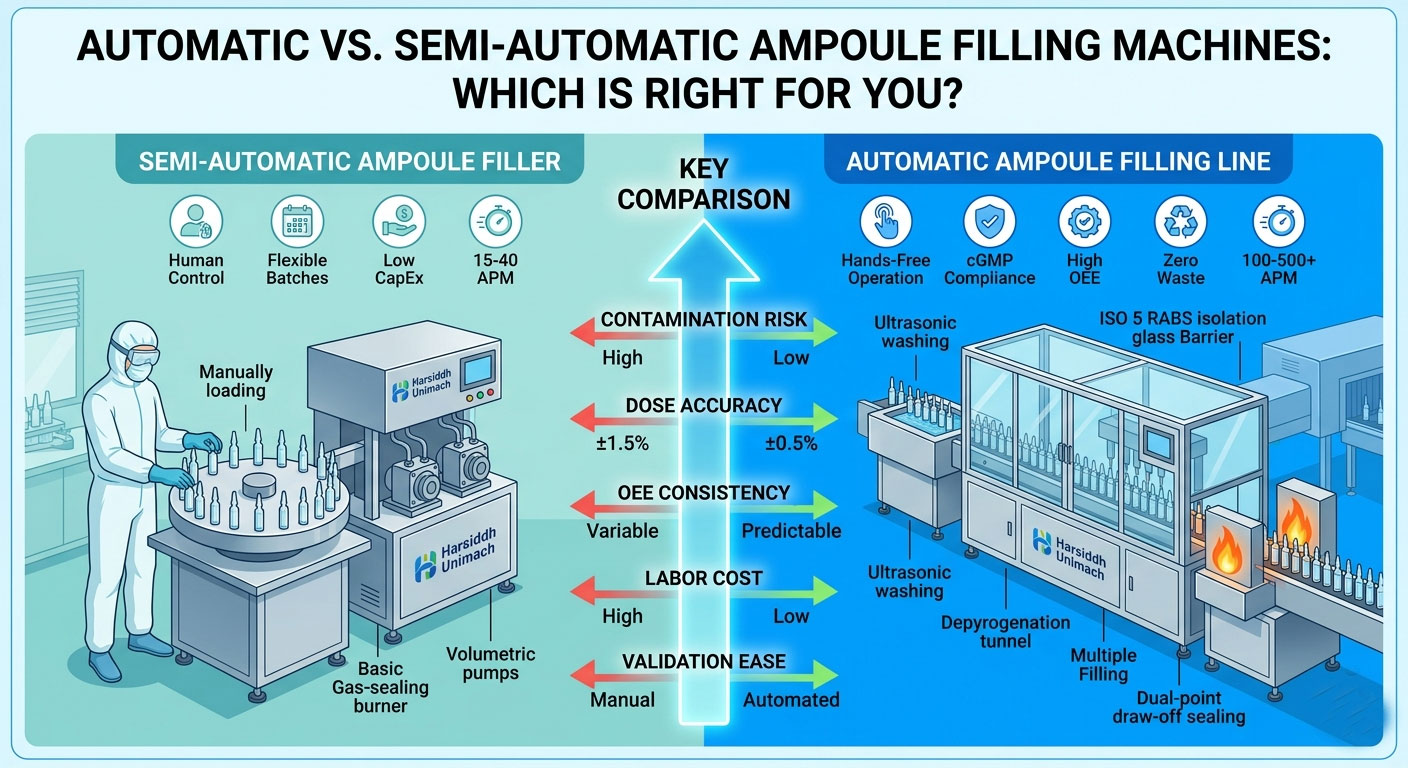
- Low-Volume / R&D Lines: 20 to 60 ampoules per minute (APM). These are usually semi-automatic or compact automatic machines optimized for quick changeovers, small trial batches, and clinical research phases.
- Medium-Volume Production Lines: 100 to 240 APM. Ideal for growing regional manufacturers or contract development and manufacturing organizations (CDMOs) handling multiple product types.
- High-Speed Industrial Lines: 300 to 500+ APM. Continuous-motion, fully integrated lines designed for single-product dedicated manufacturing where maximum throughput and automated line synchronization are non-negotiable.
The Footprint and Layout Challenge
A common oversight during machine procurement is cleanroom floor space. High-speed continuous lines require significantly larger footprints and strict linear configurations. If your cleanroom layout has structural pillars or strict zoning constraints, you need an engineering partner like Harsiddh Unimach who can customize the machine chassis layout—whether inline, L-shaped, or monoblock—to fit your facility’s spatial realities without disrupting laminar airflow paths.
2. Choosing the Ideal Dosing and Filling Technology
The physical and chemical properties of your pharmaceutical liquid dictate the type of filling mechanism required. A mismatch here can cause liquid shearing, particulate generation, or inaccurate dosing.
+--------------------------+----------------------------+----------------------------+
| Pump Type                | Best Suited For            | Major Advantage            |
+--------------------------+----------------------------+----------------------------+
| Rotary Piston Pumps      | Standard aqueous solutions | Exceptional long-term      |
|                          | and low-viscosity liquids  | volumetric accuracy        |
+--------------------------+----------------------------+----------------------------+
| Peristaltic Pumps        | Highly sensitive biologics | Zero cross-contamination;  |
|                          | and shear-sensitive fluids | disposable tubing paths    |
+--------------------------+----------------------------+----------------------------+
| Time-Pressure Dosing     | Suspensions, oils, and     | No moving parts; minimal   |
|                          | variable-viscosity fluids  | mechanical wear            |
+--------------------------+----------------------------+----------------------------+
Volumetric Rotary Piston Pumps
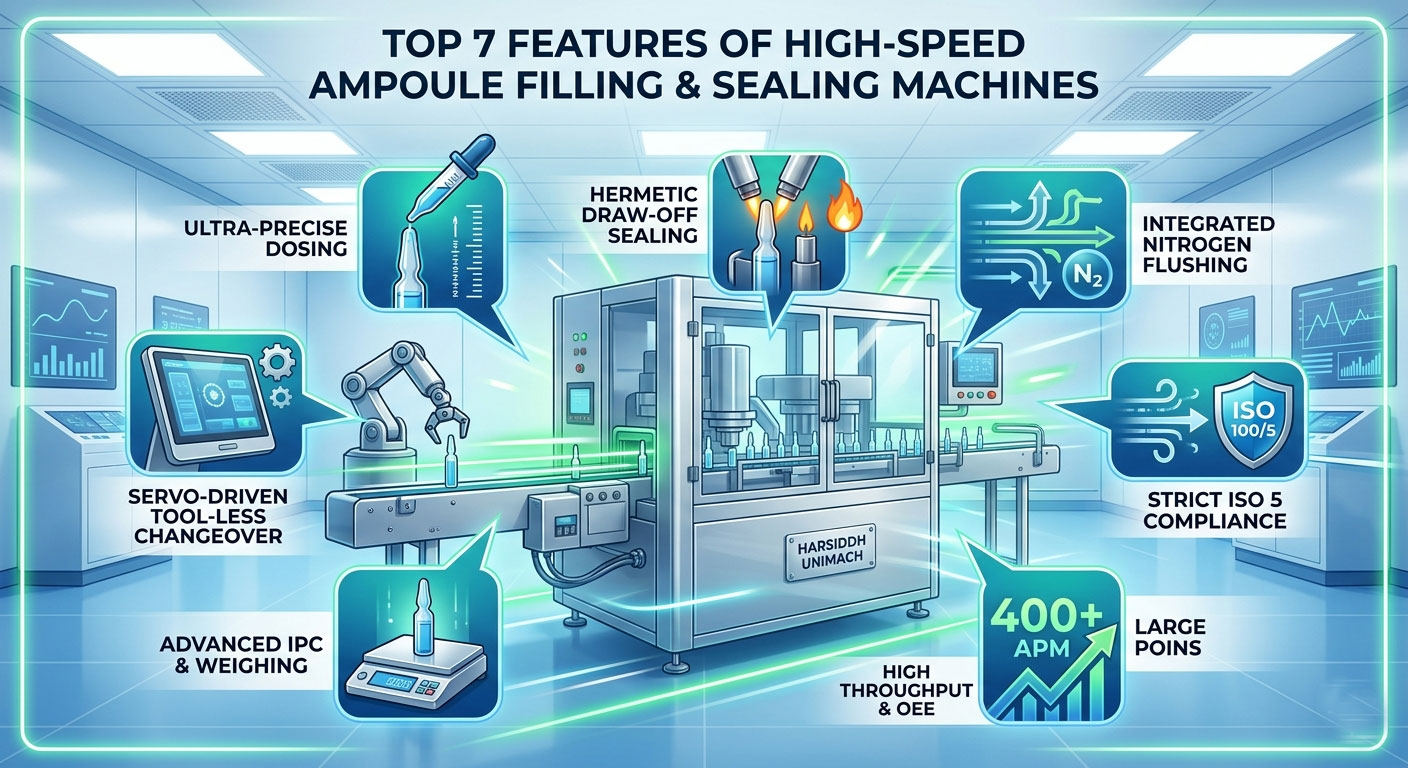
Constructed from high-grade Stainless Steel 316L or technical ceramics, these pumps offer incredible precision (typically within $\pm 0.5\%$). They work by physical displacement. However, because they feature close-tolerance moving metal or ceramic parts, they may not be ideal for highly abrasive suspensions or extremely shear-sensitive biological molecules that could degrade under mechanical friction.
Peristaltic Pumps
For modern biopharmaceuticals, gene therapies, and cytostatic drugs, peristaltic filling has become the gold standard. The liquid only touches the medical-grade silicone tubing, completely eliminating the risk of cross-contamination and simplifying the validation process. Tube changes can be executed in minutes, radically reducing product-to-product changeover times.
Time-Pressure Dosing Systems
In these systems, the product vessel is pressurized, and a highly precise pinch valve opens for a strictly calculated millisecond window. Because there are no mechanical moving parts in the fluid path, particulate generation is virtually zero. This system adapts beautifully to viscous liquids or products that react poorly to mechanical agitation.
3. The Science of Perfect Sealing and Gas Flushing
An ampoule filling line is only as good as its sealing station. The sealing process determines the long-term container closure integrity (CCI) of the primary packaging.
Pre- and Post-Gas Flushing (Nitrogen Injection)
Many injectable formulations are highly prone to oxidation when exposed to ambient air. To preserve shelf-life and drug efficacy, oxygen levels inside the ampoule head space must often be reduced to below $1\%$.
A premium filling machine must integrate a dual gas flushing mechanism:
- Pre-filling flushing: Displaces oxygen from the empty glass ampoule shell with ultra-pure nitrogen.
- Post-filling/Pre-sealing flushing: Purges any ambient air introduced during the liquid dosing phase immediately before the neck is fused shut.
Sealing Mechanisms: Tip Sealing vs. Draw-Of Sealing
The mechanical method used to close the glass neck significantly impacts the cosmetic finish and seal reliability.
- Tip Sealing (Bead Sealing): The ampoule neck is heated uniformly while rotating, causing the glass at the tip to melt, flow inward, and fuse into a rounded bead. This requires highly precise gas-oxygen mixing parameters to avoid carbon deposition or under-sealed capillaries.
- Draw-Off Sealing: The top portion of the ampoule neck is heated while grippers pull the excess glass away, fusing the neck closed during the draw. This method is highly favored in high-speed automated environments as it minimizes the risk of blowholes or unequal glass distribution at the seal point.
4. Automation, Integration, and Industry 4.0 Compliance
Modern pharmaceutical manufacturing demands comprehensive data integrity to comply with global regulatory frameworks, such as the US FDA’s 21 CFR Part 11.
       [ Washing & Sterilization Tunnel ]
                       │
                       ▼
       [ Harsiddh Unimach Ampoule Filler ]
                       │
                       ▼
    ┌──────────────────┴──────────────────┐
    ▼                                     ▼
[ In-Process Control ]         [ Nitrogen Flushing ]
(Real-time weight check)       (Oxygen displacement)
    │                                     │
    └──────────────────┬──────────────────┘
                       ▼
       [ Laser Inspection / CCI Testing ]
Advanced In-Process Control (IPC)
High-end automated systems include non-destructive IPC modules. These systems use load cells to weigh empty ampoules immediately before filling and re-weigh them post-filling. The system dynamically calculates the net fill weight. If a trend toward under- or over-filling is detected, the PLC automatically transmits a calibration command to the dosing pumps to correct the deviation in real-time, preventing batch rejects.
SCADA and HMI Systems
The Human-Machine Interface (HMI) should feature an intuitive, multi-level access control architecture. Operators, maintenance engineers, and quality assurance personnel must have distinct login tiers. The system should automatically log every change to filling speeds, temperature setpoints, or gas pressure values into a secure, unalterable audit trail.
5. Regulatory Compliance and Validation Frameworks
When regulatory inspectors audit your facility, your ampoule filling line will face intense scrutiny. The machinery must be designed from the ground up to support modern isolation and sterilization protocols.
cGMP Design Requirements
Every component that comes into contact with your product must be fabricated from certified AISI 316L stainless steel, polished to a mirror finish (surface roughness $Ra < 0.4\,\mu\text{m}$) to eliminate microscopic pits where bacteria could breed. Non-contact parts are typically made from AISI 304 stainless steel. All gaskets, O-rings, and flexible tubing must carry full FDA compliance certification.
Isolation Technology: RABS and Isolators
To protect the open sterile ampoule between the gas purge and sealing phases, the machine must interface perfectly with:
- Restricted Access Barrier Systems (RABS): Physical glass barriers coupled with a continuous vertical laminar airflow ($0.45\,\text{m/s} \pm 20\%$) to maintain ISO 5 sterile air conditions over the critical processing zone.
- Aseptic Isolators: Completely sealed environments that undergo periodic, automated Vaporized Hydrogen Peroxide (VHP) sterilization cycles. The machinery internals must be engineered to resist the highly corrosive nature of VHP gas over years of continuous operation.
6. How Harsiddh Unimach Helps You Succeed
Selecting the ideal machinery can feel overwhelming given the balance of mechanical engineering, regulatory risk, and economic factors. This is where partnering with an experienced, specialized manufacturer transforms a complex procurement process into a seamless integration.
Harsiddh Unimach designs and builds high-performance, cGMP-compliant ampoule filling and sealing lines tailored precisely to the stringent demands of global pharmaceutical manufacturers.
Custom Engineering and Flexible Configurations
At Harsiddh Unimach, we recognize that no two pharmaceutical formulations are exactly alike. Whether you are processing volatile organic solvents, highly viscous oils, or delicate biological proteins, our engineering teams customize the fluid dynamics and mechanical handling of your machine. We provide bespoke configurations for:
- Interchangeable pump blocks (switching between rotary piston and peristaltic within the same chassis).
- Customized gas-flushing manifolds optimized for exceptionally low residual oxygen targets.
- Tailored mechanical transport stars and comb systems to minimize glass-to-metal impact friction, virtually eliminating micro-fissures and breakages on the line.
Seamless Line Integration and Turnkey Solutions
An ampoule filler does not operate in a vacuum. To maximize operational efficiency, it must synchronize with upstream cleaning units and downstream inspection lines. Harsiddh Unimach offers completely integrated monoblock systems that flawlessly bridge:
- Automatic Ultrasonic Ampoule Washing Machines
- Depyrogenation and Sterilization Tunnels
- Aseptic Ampoule Filling & Sealing Systems
- Online Visual Inspection Tracking Networks
By managing the entire line configuration, we eliminate integration mismatches, ensure uniform PLC communication protocols across the line, and deliver a unified validation package.
Absolute Commitment to Validation: IQ / OQ / PQ Support
We know that a machine cannot run commercial batches until it clears strict regulatory validation. Harsiddh Unimach provides an exhaustive documentation package alongside our hardware. We work closely with your internal QA teams to execute:
- Installation Qualification (IQ): Verifying that all materials, structural dimensions, wiring, and component tolerances match your User Requirement Specifications (URS).
- Operational Qualification (OQ): Testing alarms, control loops, safety interlocks, and speed variations to ensure the machine runs reliably within its design boundaries.
- Performance Qualification (PQ): Helping validate sterile runs, fill-weight consistency under actual manufacturing loads, and container closure integrity testing.
7. Procurement Evaluation Checklist
To assist your engineering and procurement teams during vendor evaluation, use this checklist to compare technical proposals against your operational realities:
[ ] Throughput Targets: Does the OPM meet current demands + a 30% expansion margin?
[ ] Product Compatibility: Is the dosing pump material inert to the formulation?
[ ] Accuracy Thresholds: Can the pump hold a +/-0.5% tolerance on micro-doses?
[ ] Gas Profiling: Does the machine offer both pre- and post-nitrogen flushing?
[ ] Structural Metallurgy: Are all contact surfaces certified AISI 316L?
[ ] Enclosure Compatibility: Can the chassis integrate with a RABS or VHP Isolator?
[ ] Audit Compliance: Does the HMI system support full 21 CFR Part 11 audit trails?
[ ] Support Ecosystem: Does the vendor offer comprehensive IQ/OQ validation protocols?
Conclusion: Making the Right Move
Investing in an ampoule filling and sealing machine is a foundational decision for your pharmaceutical line’s operational future. Prioritizing cheap initial capital costs over engineering depth can lead to expensive maintenance down the road, including recurrent downtime, batch failures, and regulatory compliance issues.
By evaluating your options through the lenses of dosing mechanics, container closure integrity, automation readiness, and validation support, you protect your investment, your brand reputation, and the patients who rely on your products.
Let Harsiddh Unimach take the complexity out of your next upgrade. Our world-class engineering team is ready to analyze your unique product specifications, cleanroom floor plans, and throughput goals to design an optimized, validation-ready sterile filling line.
Partner with Harsiddh Unimach Today
Ready to elevate your pharmaceutical production line with precision, reliability, and full regulatory compliance? Reach out to the technical engineering specialists at Harsiddh Unimach today to discuss your project requirements and receive a detailed, custom-tailored machinery blueprint.