In the high-stakes world of pharmaceutical manufacturing, liquid and powder dosage forms demand unparalleled precision, absolute sterility, and strict compliance with global regulatory standards. Vials remain one of the most trusted primary packaging formats for injectables, biologics, vaccines, and complex therapies. However, because different medicinal formulations vary wildly in viscosity, chemical stability, and sensitivity, a one-size-fits-all filling approach is impossible.
To achieve maximum production efficiency while eliminating the risks of contamination or product loss, manufacturers must deploy specialized machinery tailored to their specific applications. At Harsiddh Machines (www.harsiddhmachines.com), we engineer advanced pharmaceutical packaging solutions that cater to diverse production scales and technical requirements.
This comprehensive guide explores the primary types of vial filling machines utilized in the modern pharmaceutical landscape, comparing their mechanisms, dosing technologies, and operational configurations to help you make an informed infrastructure decision.
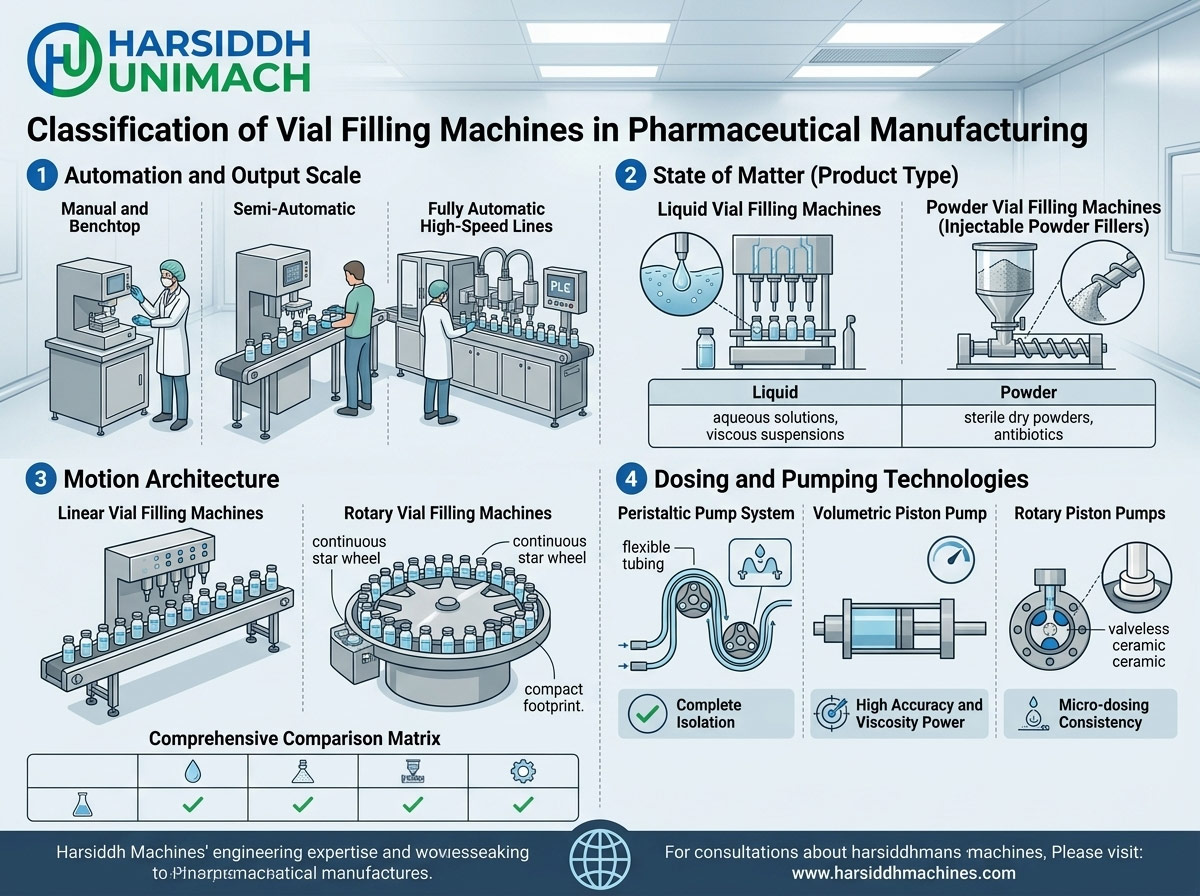
1. Classification Based on Automation and Output Scale
The first method of classifying vial fillers is by their operational architecture and production capacity. Depending on whether you are running a laboratory-scale pilot batch or continuous, multi-shift commercial manufacturing, machines are generally categorized into three groups.
A. Manual and Benchtop Vial Fillers
Designed primarily for research and development (R&D) laboratories, clinical trial batches, and small compounding pharmacies, manual or benchtop fillers require a human operator to position each vial under the dispensing nozzle.
- Key Characteristics: Low throughput, highly flexible, extremely small cleanroom footprint.
- Limitation: Higher risk of human-introduced contamination, making them less suitable for large aseptic production runs.
B. Semi-Automatic Vial Filling Machines
Semi-automatic systems strike a balance between affordability and speed. In these setups, operators typically feed the vials onto a loading platform or transport track manually, but the actual dosing, liquid dispensing, and occasional stoppering operations are handled automatically by the machine’s internal timers and pumps.
- Best Suited For: Mid-sized laboratories, pilot-scale manufacturing, and contract manufacturing organizations (CMOs) handling diverse, low-volume product lines.
C. Fully Automatic High-Speed Vial Filling Lines
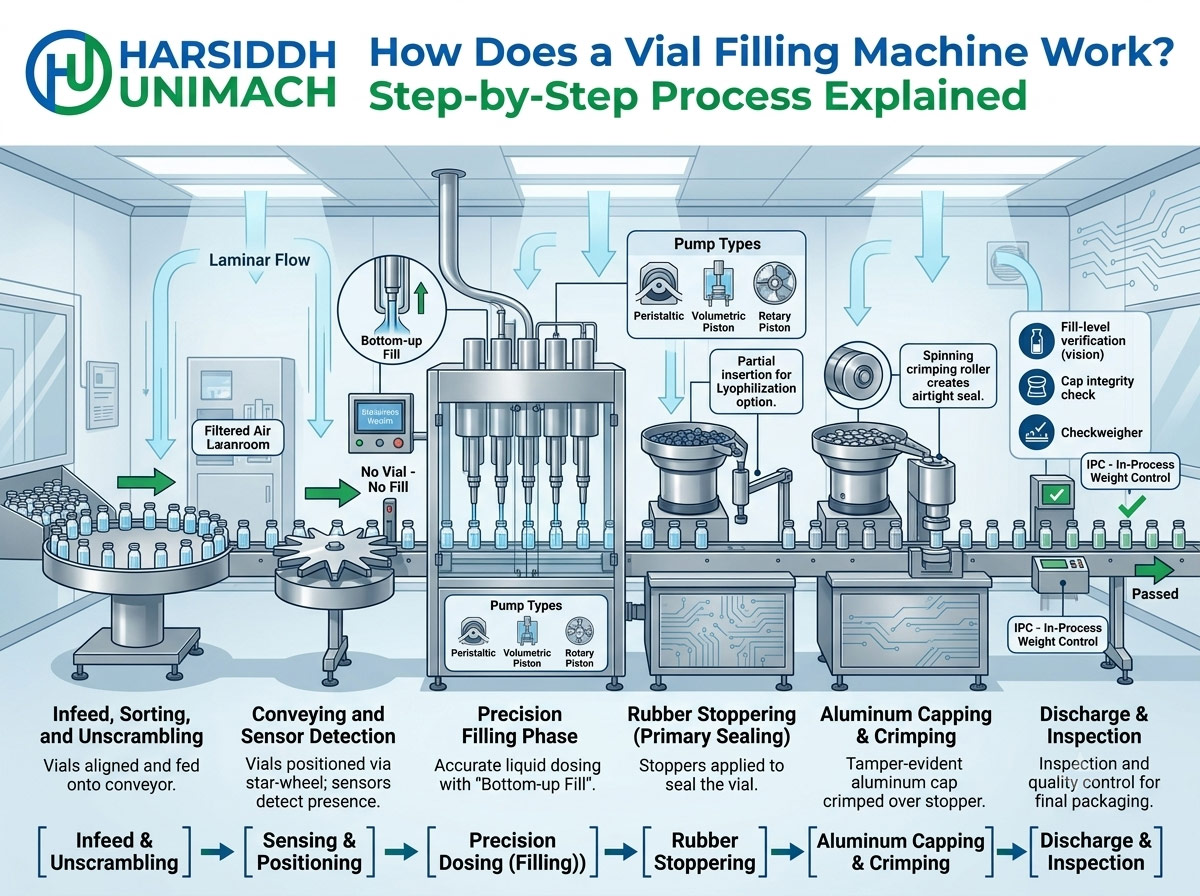
For large-scale commercial manufacturing, fully automatic lines are the industry standard. These systems operate with zero manual intervention throughout the active cycle. Empty, sterilized vials enter from a depyrogenation tunnel, pass through integrated filling, stoppering, and capping stations, and exit fully sealed.
- Key Characteristics: Integrated with advanced PLC (Programmable Logic Controller) systems, optical tracking sensors, and human-machine interfaces (HMIs).
- Throughput: Capable of processing thousands to tens of thousands of vials per hour with unmatched repeatability.
2. Classification Based on the State of Matter (Product Type)
Pharmaceutical formulations are primarily filled as liquids or dry powders. Because the physical properties of liquids and powders are fundamentally different, the mechanical design of the filler must be radically altered to handle each format safely.
A. Liquid Vial Filling Machines
Liquid fillers are designed to handle everything from water-thin aqueous solutions (like saline or standard injectables) to highly viscous suspensions and oils. These machines focus heavily on avoiding fluid turbulence, splashing, foaming, and dripping. They utilize precise fluid-path technologies to ensure that the chemical structure of delicate proteins or biopharmaceuticals is not altered by mechanical shear stress during dispensing.
B. Powder Vial Filling Machines (Injectable Powder Fillers)
Certain life-saving antibiotics, crystalline drugs, and lyophilized products are highly unstable when stored in liquid form. These are manufactured as sterile dry powders that are reconstituted with a solvent immediately before administration.
- The Mechanism: Powder filling requires a highly specialized dosing system—typically a micro-auger or a vacuum-assisted volumetric wheel.
- The Challenge: Preventing static charge buildup, minimizing airborne ambient dust within the sterile enclosure, and ensuring that fine particles do not clog the sealing components or prevent the rubber stopper from seating correctly.
3. Classification Based on Motion Architecture
The way vials move through the active filling zone dictates both the footprint of the machinery and the speed at which it can process containers.
A. Linear Vial Filling Machines
In a linear filling system, vials travel in a straight line along a continuous conveyor track. When they reach the filling zone, a pneumatic indexing gate stops a specific batch of vials (typically in groups of 2, 4, 6, or 8) directly underneath a matching manifold of multiple filling nozzles.
[Infeed] ➔ [ V | V | V | V ] ➔ [ Stop & Fill Zone ] ➔ [ V | V | V | V ] ➔ [Outfeed]
- Advantages: Straightforward mechanical design, simpler maintenance protocols, and significantly easier changeover procedures when switching between different vial sizes.
- Best Used For: Moderate to high-volume production lines where rapid changeover times between different product batches are highly prioritized.
B. Rotary Vial Filling Machines
Rotary systems utilize a continuous-motion or intermittent-motion circular star wheel. Vials are captured individually within custom-machined “pockets” along the periphery of a spinning carousel, moving smoothly past filling, stoppering, and sealing heads arranged in a compact circle.
- Advantages: Extremely high throughput capacities and a drastically minimized cleanroom footprint compared to long linear tracks. The smooth circular motion reduces vial-on-vial impact, significantly lowering the risk of glass breakage or cosmetic defects at high speeds.
- Best Used For: Massive, dedicated commercial production runs where maximizing output per square meter of cleanroom space is critical.
4. Dosing and Pumping Technologies: A Critical Choice
The core heart of any liquid vial filling machine is its pumping technology. Selecting the correct pump determines the ultimate accuracy of your line, the ease of cleaning, and the protection of your product formulation.
1. Peristaltic Pump Systems
Peristaltic pumps have quickly become the gold standard for filling high-value biologics, vaccines, and advanced therapy medicinal products (ATMPs).
- How It Works: The liquid product is drawn through a flexible, sterile medical-grade silicone tube. A set of rotating rollers compresses the exterior of the tubing, pushing the fluid forward volumetric step by volumetric step.
- Primary Benefit: Complete isolation. The liquid never comes into contact with any mechanical parts, gears, or internal valves of the machine itself—it only touches the inside of the disposable tube. This fundamentally eliminates the risk of cross-contamination and simplifies product changeovers down to a simple matter of replacing the single-use tubing assembly.
2. Volumetric Piston Pumps
Piston pumps utilize a high-precision machined cylinder and piston assembly to mechanically draw a predefined volume of liquid into a chamber during the intake stroke and expel it into the vial during the discharge stroke.
- Primary Benefit: Exceptional long-term accuracy, highly robust durability, and the mechanical power necessary to accurately push highly viscous or thick liquid products without drift.
- Considerations: Requires meticulous, manual dismantling for validation cleaning and sterilization between different product batches to avoid cross-contamination.
3. Rotary Piston Pumps (Ceramic or Stainless Steel)
Operating similarly to traditional piston pumps, rotary piston systems rotate the piston slightly during each stroke to act as its own valve mechanism.
- Primary Benefit: Often constructed from solid, highly polished valveless ceramics, these components eliminate metal-on-metal friction and avoid particle shedding into the formulation. They are highly favored for micro-dosing applications where sub-milliliter volumes must be dispensed with strict consistency over millions of cycles.
5. Comprehensive Comparison Matrix
| Feature | Linear Peristaltic Filler | Rotary Piston Filler | Injectable Powder Filler |
| Primary State handled | Liquids (Low to Mid Viscosity) | Liquids (Mid to High Viscosity) | Sterile Dry Powders / Crystals |
| Dosing Technology | Peristaltic (Silicone Tubing) | Volumetric Piston (Ceramic/SS) | Vacuum Wheel / Micro-Auger |
| Speed / Throughput | Moderate to High | Extremely High | Moderate to High |
| Risk of Cross-Contamination | Lowest (Single-Use Fluid Path) | Moderate (Requires CIP/SIP) | Low to Moderate (Dust Control Needed) |
| Changeover Complexity | Low (Fast recipe change) | High (Mechanical swaps) | Moderate |
| Ideal Application | Biologics, Vaccines, Cytotoxics | Large-run injectables, Syrups | Sterile Antibiotics, Lyophilized items |
6. Advanced Environmental Configurations
Beyond the internal mechanics and pump choices, modern pharmaceutical vial filling machines must be categorised by how they interface with the cleanroom environment to guarantee product safety.
A. Open Vial Filling Systems
These machines operate openly within a traditional, high-grade cleanroom environment (typically Grade A/Class 100 laminar flow hoods). While effective for non-hazardous, stable liquid pharmaceuticals, they require strict gowning and strict behavioral protocols for operators, as humans remain the largest source of microbial contamination.
B. RABS (Restricted Access Barrier Systems)
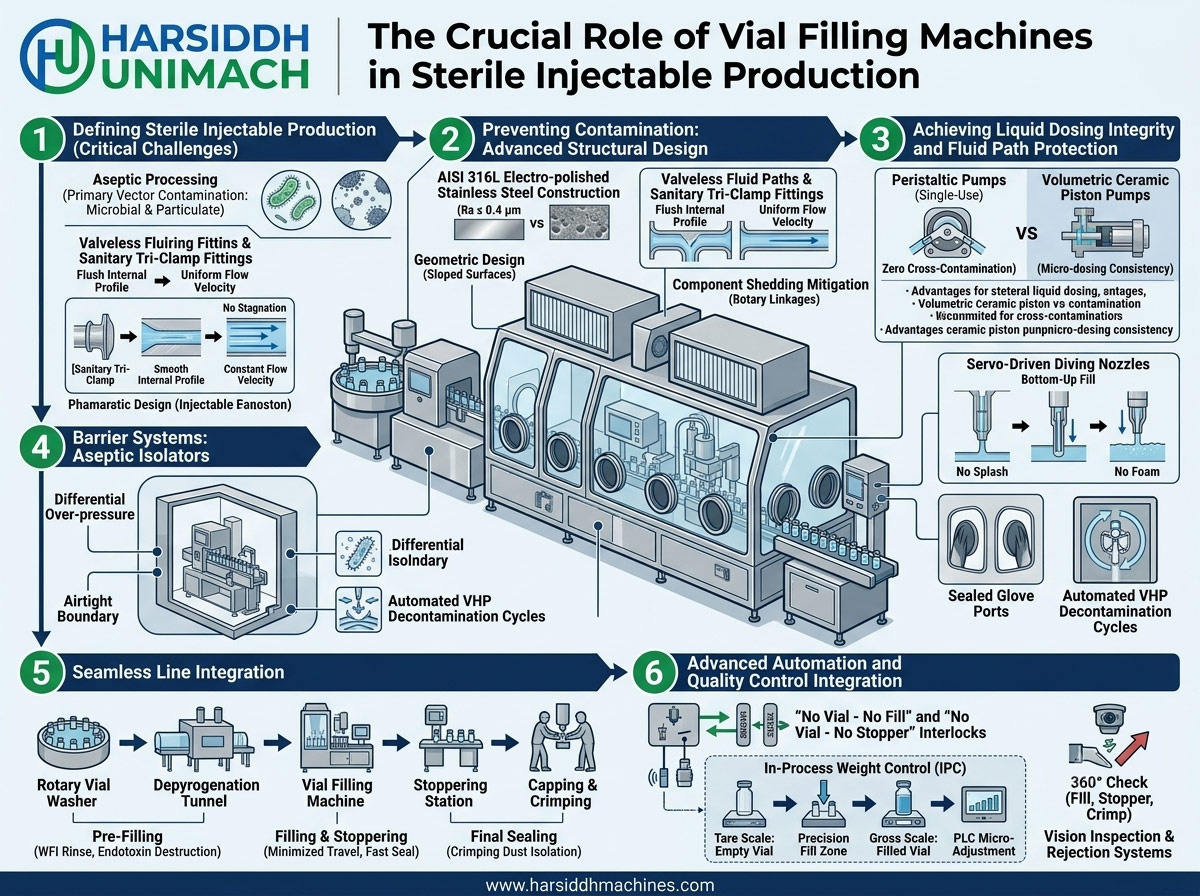
A RABS features a solid physical glove-box enclosure built around the active filling line, combined with a continuous unidirectional laminar flow of HEPA-filtered air. Operators can only interact with the internal machinery, components, or vials via sealed glove ports. This significantly reduces the risk of environmental contamination without completely isolating the process.
C. Aseptic Isolator Systems
For highly potent compounds, hazardous oncological drugs (cytotoxics), or advanced biologics requiring absolute sterility, complete Aseptic Isolators are deployed. The filling machine is entirely sealed inside an airtight, autonomous environment that undergoes automated VHP (Vaporized Hydrogen Peroxide) decontamination cycles. Isolators provide the highest possible safety margin for both the product and the cleanroom operators.
Choosing the Ideal Partner for Your Production Line
Selecting the perfect vial filling machine requires a deep balance between your liquid’s rheological properties, your planned production throughput, and your cleanroom infrastructure. Choosing an incorrectly specified pump or motion style can lead to product shearing, frequent maintenance downtime, or regulatory compliance failures.
At Harsiddh Machines, we specialize in designing and manufacturing top-tier pharmaceutical machinery tailored to the evolving demands of global biotechnology and medical manufacturing. Whether your facility requires a highly adaptable linear peristaltic line for multi-product biopharmaceutical runs, or a rugged, high-speed rotary piston system for mass commercial production, our engineering team works hand-in-hand with you to build a system that guarantees precision, safety, and operational longevity.
Visit our official website at www.harsiddhmachines.com to explore our comprehensive product catalog, view technical datasheets, or schedule an engineering consultation with our technical specialists today.